where the sea receives what we carry.
A spring ritual from Okinawa, where purification becomes a way of returning to the natural rhythm of life.
 By valentin
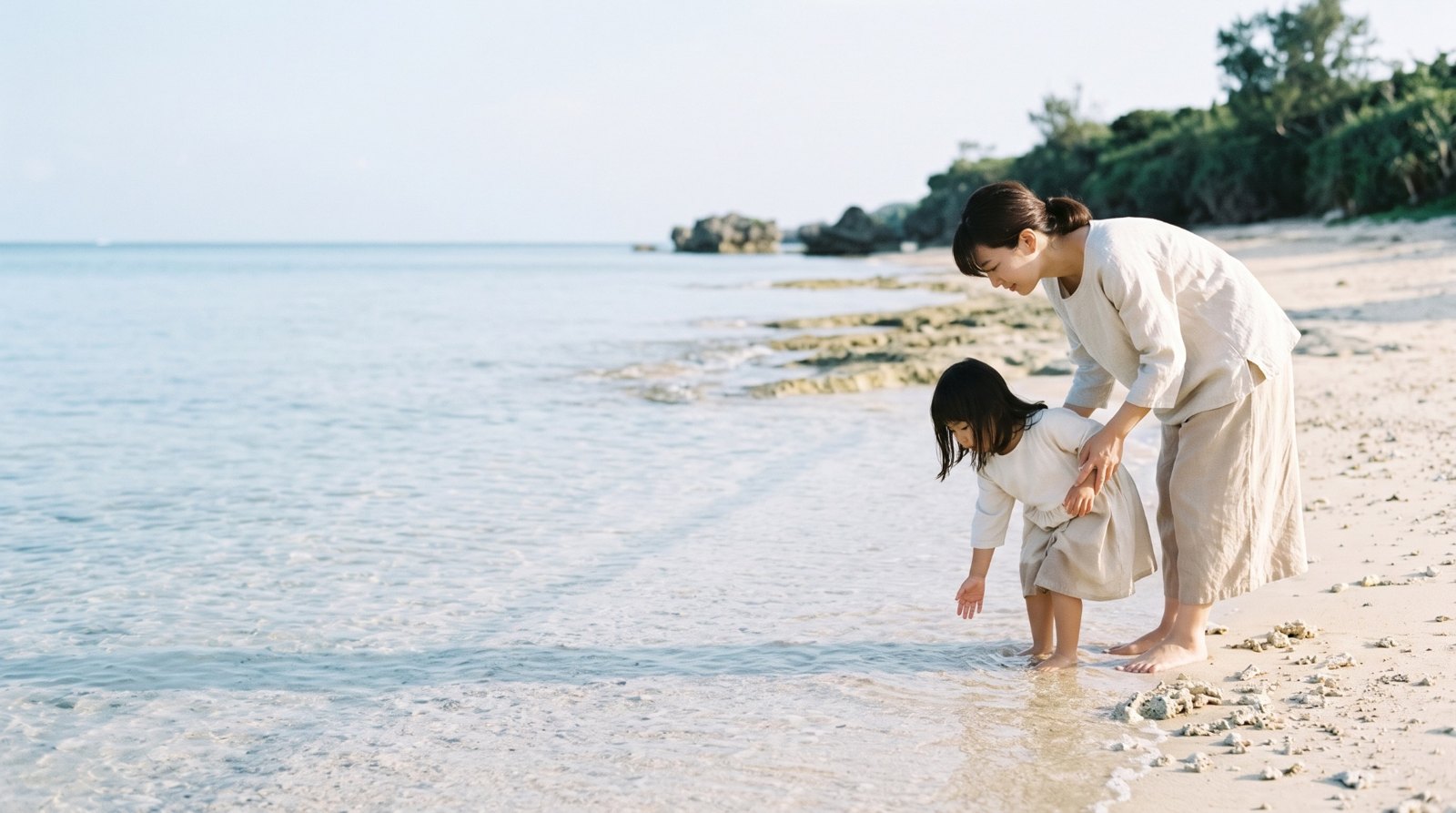
There are certain places where the world seems softer at its edges.
The tide moving over pale sand. The faint sound of water folding back into itself. The momentary trace of footsteps, already beginning to disappear.
In Okinawa, the sea has long been more than a landscape. It has been a source of life, a threshold of imagination, and a place where spiritual meaning is felt as much as explained.
Among the island’s traditional observances, Hamauri carries this relationship with particular grace. Through a simple movement toward the shore, it expresses an ancient desire for cleansing, protection, and renewal.
A Ritual by the Shore
Hamauri (浜下り) can be understood as “going down to the beach” or “descending to the shore.” It is traditionally observed on the third day of the third month of the old lunar calendar, when spring is beginning to settle over the islands.
Historically, the custom was especially associated with women and young girls. They would go to the seaside, place their hands and feet in the water, and pray for health, purity, and freedom from misfortune.
The act itself is striking in its simplicity.
No elaborate ornament is needed. The shore, the body, and the sea are enough.
It is perhaps this quiet directness that has allowed the ritual to remain so moving. A gesture does not need to be grand in order to carry meaning. Sometimes the smallest act is the one that opens the deepest space for reflection.
The Legend Behind Hamauri
Like many living traditions, Hamauri is accompanied by oral stories that help explain its spiritual significance.
One of the best-known legends tells of a young woman who was visited by a mysterious man. Unsure of who he truly was, her family encouraged her to attach a thread to his clothing in secret. When they followed it the next day, it led them to a cave where they discovered that the visitor had in fact been a serpent, often identified in Okinawan retellings as Akamata.
According to the story, the young woman had fallen under his influence and was carrying his child. She was then brought to the seashore, where immersion in the ocean freed her from that bond and restored her.
Whether told literally or symbolically, the legend gives shape to an enduring belief: the sea is capable of removing what does not belong, of washing away impurity, and of returning a person to a more balanced state.
The story belongs to a specific cultural and spiritual landscape, and it deserves to be approached with respect. Yet even from a distance, one can sense the emotional truth it carries. There are times in life when we wish to step out of what has troubled us and begin again.
The Spiritual World of Okinawa
To understand Hamauri more fully, it helps to remember that Okinawa’s spiritual culture developed differently from that of mainland Japan.
The Ryūkyū Islands nurtured their own religious imagination, shaped by local beliefs, by the presence of female spiritual figures, and by a deep reverence for the natural world. Sacredness was not limited to formal sanctuaries. It could also be felt in groves, caves, stones, springs, and coastal spaces.
Within this worldview, nature is not a passive backdrop. It participates in the life of the community.
The sea in particular holds a powerful place in Okinawan thought. In older belief, Nirai Kanai is a divine realm said to lie beyond the ocean, from which blessings, fertility, and abundance may arrive. Even when Hamauri is not directly about that belief, it belongs to the same wider sensibility: the sense that the sea is not empty distance, but a place of relation.
This helps explain why stepping into the water can become more than a practical or symbolic action. It becomes a meeting point between the human and the unseen.
Women, Purification, and Continuity
The historical role of women in Hamauri is also meaningful.
In Okinawan tradition, women have often held important ritual and spiritual roles within both household and communal life. Their presence in rites of prayer and protection reflects a wider cultural inheritance that remains distinctive within the region.
Hamauri therefore speaks not only of the sea, but also of transmission.
A mother teaching a gesture. A grandmother explaining a date on the traditional calendar. A child learning, perhaps without yet understanding fully, that certain days are approached differently from others.
Traditions are often preserved in this quiet way. Not through grand declarations, but through repetition, care, and embodied memory.
The Tide as Teacher
Spring low tide also plays a part in the emotional atmosphere of Hamauri.
At this time, the receding water reveals portions of the shore that are usually hidden. Pools gather between rocks. Shells appear. The seabed briefly offers what it normally keeps out of sight.
There is something beautiful in that rhythm.
What withdraws also reveals. What disappears may leave behind another form of presence.
Perhaps this is one reason the ritual still resonates beyond its formal religious meaning. It offers an image of change that is neither violent nor abrupt. The sea does not demand. It moves, returns, and reshapes the shore with patience.
It reminds us that release can be gentle.
Hamauri Today
Like many cultural practices, Hamauri has changed over time.
In contemporary Okinawa, it may still carry spiritual meaning, but it is also a day of family gathering and seasonal togetherness. People visit the coast, children play near the water, food is shared, and the shoreline becomes a place of memory as well as ritual.
Traditional sweets and spring foods may accompany the day, linking it not only to belief, but to the familiar textures of communal life.
This evolution does not diminish the ritual. If anything, it reveals one of the quiet strengths of tradition: its ability to remain alive by adapting without severing its roots.
What continues is not always the exact form of the past, but the attention that the past has taught us to give.
What the Sea Teaches Us to Release
There is a tenderness in rituals of purification.
Not because they promise that life will become simple, or that sorrow can be erased, but because they acknowledge a human need to begin again. To step into water. To pause. To let the body take part in a prayer the mind cannot fully express.
Hamauri can be understood in its historical and cultural specificity, and it should be. But it may also speak to something more universal.
That there are burdens we carry too long.
That not every trace must remain visible in order to have mattered.
That renewal is sometimes less about becoming someone new than about returning, quietly, to oneself.
The sea receives what the shore cannot keep forever.
And perhaps that is why this ritual still feels so moving.
It does not ask us to forget.
Only to trust that some things may be offered back to the tide.
Closing lines
The water rises.
The footprints fade.
The light lingers a little longer.
And life, without needing to announce it, begins again.