what we carry in our prayers.
An Okinawan tradition of sacred offerings, devotion, and the intentions we carry with us.
 By valentin
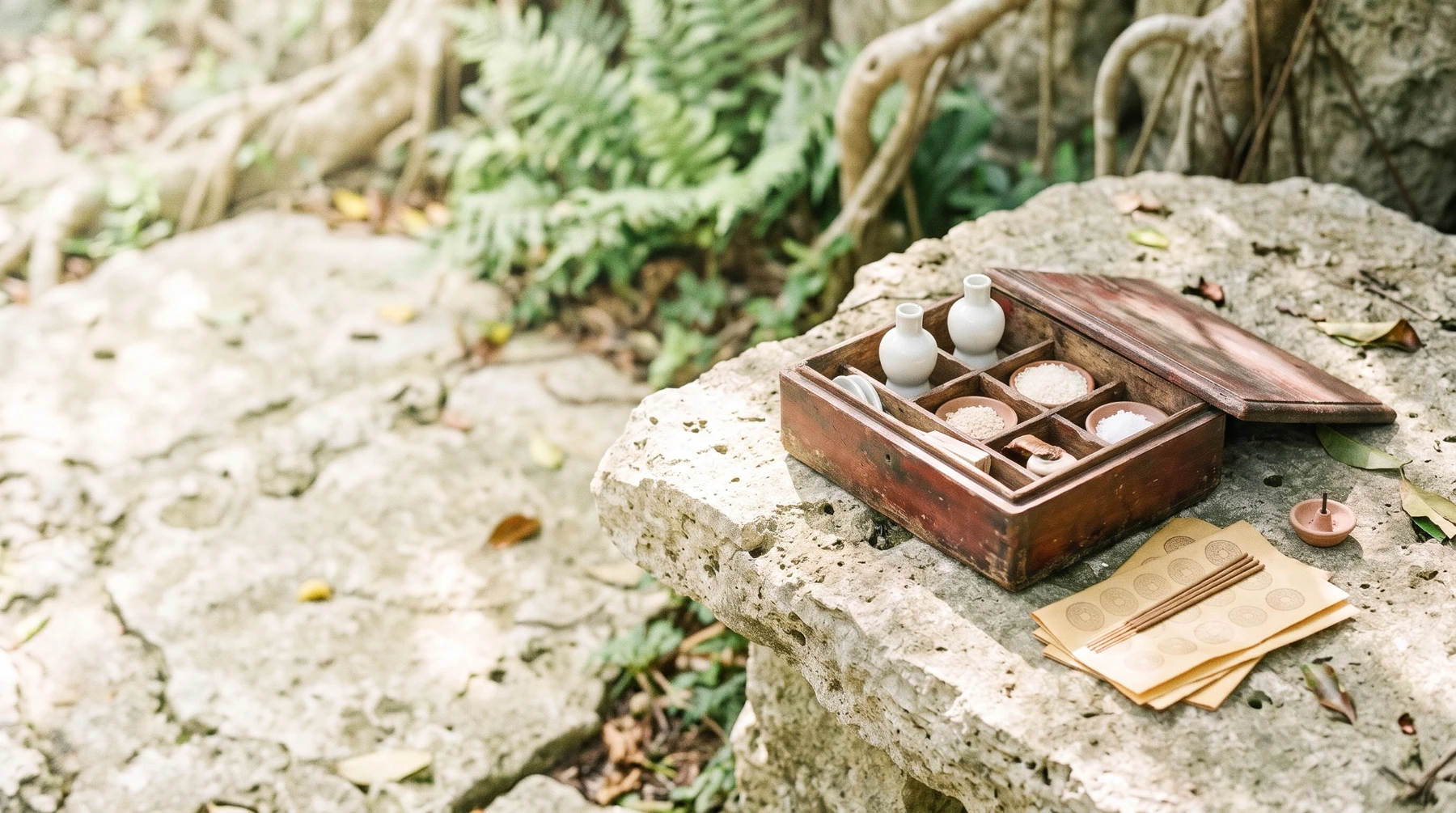
Some objects are small enough to pass unnoticed, yet they hold entire ways of relating to the world.
A wooden box. A little rice. A pinch of salt. A cup prepared with care before prayer begins.
In Okinawa, one such object is the Binshī (ビンシー / 瓶子), a ritual box used when bringing offerings for ugan, traditional prayers offered at sacred places.
At first glance, it may appear modest.
And yet, within it are gathered the materials of devotion, the gestures of respect, and the intention to approach the unseen with care.
A Box Made for Prayer
The Binshī is a portable wooden offering box used in Okinawan ritual life.
It accompanies prayers made both within the household sphere and at outdoor sacred places, where offerings are prepared and presented with attention.
Traditionally, the box is designed with compartments so that the necessary items can be carried together in an orderly way.
Depending on the family and the occasion, it may contain rice, salt, cups for ritual drink, and other materials associated with prayer. A lower drawer may also hold incense and paper offerings used during ugan.
Its usefulness is practical, but not merely practical.
The Binshī gathers what is needed so that prayer may be made properly. It brings order to what might otherwise be scattered. In this sense, it is not only a container, but a companion to ritual.
The Care Given to Offerings
In many spiritual traditions, offerings are not measured only by what they consist of, but by the care with which they are prepared.
This is especially moving in the case of the Binshī.
The ingredients are simple. Rice. Salt. A small cup. Incense. White paper.
Nothing here seeks extravagance.
And perhaps that is precisely the point.
What matters is not display, but sincerity.
An offering may be materially humble and still carry great meaning. Through preparation, arrangement, and intention, ordinary things are gently set apart from ordinary use.
They become part of a gesture of reverence.
The Binshī gives form to that transformation.
Okinawa and the World of Ugan
To understand the Binshī more fully, it helps to remember that Okinawa’s spiritual culture has its own distinct history.
The Ryūkyū Islands developed ritual traditions shaped by local beliefs, ancestral practices, and deep reverence for sacred places.
Prayer in this context is often described through the word ugan (御願), a term referring to acts of devotion addressed to deities, ancestors, or protective presences connected to place and household life.
Such prayers may be performed at utaki, family tombs, temple sites, household spaces, and other places regarded as spiritually significant.
The Binshī belongs to this wider landscape of devotion.
It is not the sacred object itself. Rather, it is the object that helps one approach the sacred with readiness and respect.
There is something beautiful in that role.
Not every meaningful object stands at the center of attention. Some serve quietly from the side, making reverence possible.
What a Box Can Hold
The Binshī reminds us that containers are never only physical.
A box can hold materials.
It can also hold habits, memories, and inherited ways of doing things.
A family may keep its own understanding of how offerings are arranged. An elder may teach when it is appropriate to bring the box, what should be placed inside, and how each item is to be prepared.
Through this, the object becomes part of transmission.
It holds not only offerings, but knowledge.
What is passed on is not merely a list of materials. It is a way of paying attention.
A way of remembering that even the smallest elements of ritual deserve care.
An Object That Is Not Lightly Shared
One of the striking cultural ideas associated with the Binshī is that it is often treated as something deeply connected to the household itself.
In Okinawan custom, it has sometimes been compared to a family seal in the sense that it belongs to the house and should not be casually lent to others.
This reveals something important.
The Binshī is not just a useful box. It carries a relationship between the household and its devotional life.
It belongs to a particular continuity of care.
Even this detail feels meaningful to me.
Some objects become intimate not because of their beauty alone, but because of the place they occupy in the invisible structure of a life.
Carrying Intentions
What moves me most about the Binshī is the quiet symbolism of carrying prayer from one place to another.
A person prepares the offerings.
The box is lifted by hand.
It travels toward a place of prayer.
And with it travel hope, gratitude, remembrance, and concern for what cannot be fully controlled.
This movement feels deeply human.
We all carry things that are not visible.
Worries we do not name aloud. Wishes for those we love. Gratitude we have not yet expressed. Longings we do not know how to resolve.
Perhaps prayer, in one sense, is a way of giving these inner movements a form.
The Binshī becomes beautiful to me because it reflects this so simply.
A small wooden box, carrying what words alone cannot always contain.
The Sacred in Modest Things
There is a tendency, at times, to imagine the sacred as something distant, grand, or inaccessible.
And yet many traditions remind us that it may also appear in humble forms.
A bowl of water.
A folded paper offering.
A thread.
A candle.
A box made of wood.
The Binshī belongs to this quieter world of sacred objects.
It does not dazzle. It does not ask to be admired.
It asks only to be used with respect.
I think this is one of the reasons it feels so right for contemplation.
It tells us that spiritual depth is not always announced through spectacle. Sometimes it is carried in objects that remain plain, patient, and near at hand.
What We Bring With Us
In the end, perhaps the Binshī invites a simple but enduring question.
What do we carry with us when we approach what matters most?
Not only in ritual, but in life.
Do we come hurried, distracted, and half elsewhere?
Or do we arrive with care?
With humility.
With some small offering of attention.
The Binshī teaches nothing through words. It carries no doctrine on its own.
Yet in its quiet presence, it suggests that sincerity is something we prepare.
That reverence may begin long before prayer itself.
And that even a modest object can help us remember how to approach the invisible with both hands.
Perhaps this, too, is a form of beauty.
Not what is grandly displayed, but what is carefully brought.
What we carry.
What we prepare.
And what, in silence, we place before the sacred.