may you always find your way home.
A Lao tradition of blessings, belonging, and the invisible bonds that keep us close.
 By valentin
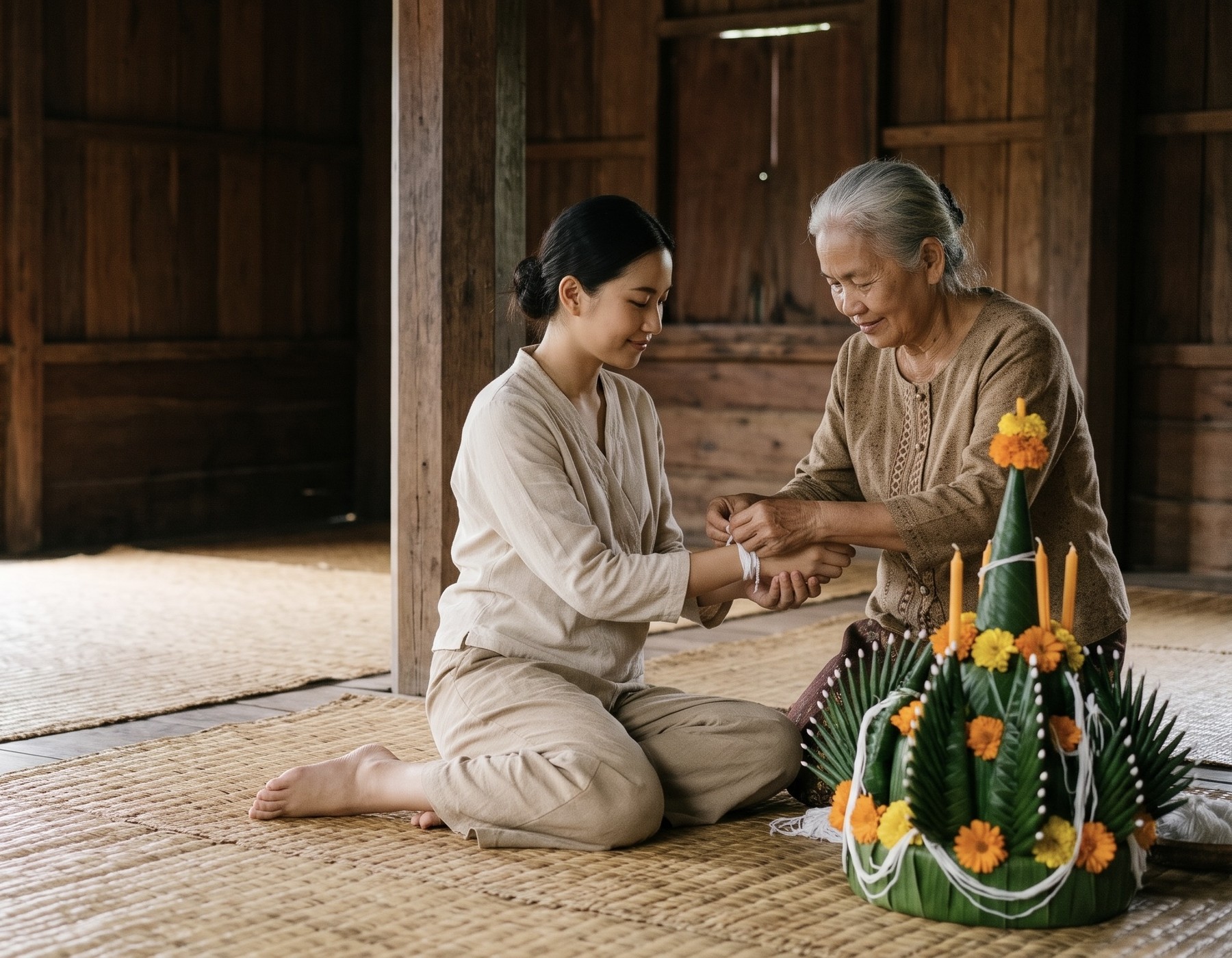
A white cotton thread rests between two hands.
One belongs to the person offering a blessing. The other belongs to someone about to receive it.
Around them, relatives and friends have gathered. Flowers have been arranged, candles have been lit, and words of encouragement are spoken with affection.
In Laos, this gesture belongs to a ceremony known as Baci (ບາສີ), also called Sou Khuan (ສູ່ຂວັນ).
It accompanies some of the most significant passages of human existence, bringing people together to wish one another health, happiness, protection, and inner harmony.
At its heart lies an ancient understanding of well-being: that a person is sustained not only by what exists within them, but also by the relationships that surround them.
Calling the Khuan Home
The origins of Baci lie in the traditional spiritual beliefs of Laos, many of which existed before the arrival of Theravāda Buddhism.
Over the centuries, these beliefs have continued to coexist with Buddhist practices, contributing to the distinctive religious landscape of the country.
Central to the ceremony is the concept of khuan (ຂວັນ), a term that can be understood as a spiritual essence or vital presence.
According to a traditional Lao belief, thirty-two khuan are associated with different parts of the human body. Together, they contribute to a person's vitality and equilibrium.
These spiritual presences are believed to be capable of wandering away, particularly during illness, distress, travel, or important changes in life.
The purpose of Baci is to call them back.
Through spoken invocations, offerings, and the tying of cotton threads, those gathered express a wish for the recipient to recover or preserve their sense of harmony.
The ceremony gives a visible form to something that cannot be seen: the desire for another person to feel whole.
Preparing a Place for Blessings
Before the ceremony begins, a special arrangement known as a pha khuan is prepared.
Usually placed at the center of the gathering, it consists of carefully folded banana leaves, arranged into a conical structure and decorated with flowers, often golden or orange marigolds.
White cotton threads are attached to the arrangement, while candles, fruit, eggs, and other offerings may be placed around its base.
Its preparation requires knowledge and careful handiwork.
The leaves are folded into precise shapes. Flowers are positioned individually. The threads are made ready for those who will receive them.
Family members and guests then sit together around the arrangement.
A respected elder or ritual specialist, often known as a mor phon, leads the ceremony. Through traditional recitations, the khuan are invited to return, while wishes for prosperity, safety, and good health are expressed.
The preparation of the ceremony is itself an act of generosity. Time and effort have been given so that someone else may receive a blessing.
A Thread Around the Wrist
One of the most recognizable moments of Baci is the tying of white cotton threads around the wrists.
The color white is associated with auspicious qualities such as peace and purity.
As each thread is tied, the person offering it may speak a blessing, wishing the recipient a safe journey, good health, happiness, or success in the life that awaits them.
The threads are understood to help keep the returning khuan in harmony with the body.
Participants commonly continue wearing them for at least three days, although customs may vary between families and communities.
Long after the gathering has ended, these modest bands of cotton remain.
They accompany the movements of everyday life, resting against the skin as tangible reminders of the affection and goodwill expressed during the ceremony.
What might otherwise have disappeared with the spoken words is given a small, lasting presence.
The Passages of Life
Unlike celebrations associated with a fixed date on the calendar, Baci follows the circumstances of human life.
It may welcome a newborn child, accompany a marriage, mark the beginning of a journey, or celebrate the return of someone who has been away.
It can also be performed during periods of illness or emotional difficulty, when a person needs the reassurance and support of those around them.
In this sense, the ceremony belongs equally to joy and vulnerability.
The words spoken around the pha khuan are shaped by the occasion and by the particular needs of the person receiving them.
A traveler may receive wishes for protection along the road.
A newly married couple may be blessed with harmony and prosperity.
Someone recovering from illness may be surrounded by encouragement and affection.
The circumstances change, but the gathering retains a common purpose: to accompany another human being through a moment of transition.
The Generosity of Wishing Someone Well
There is something remarkable about a ceremony in which people gather simply to express their hopes for another person's life.
They cannot determine what the future will bring. They cannot prevent every difficulty or promise that the journey ahead will be without hardship.
What they can offer is their presence.
Their attention, their affection, and the sincerity of their wishes.
Baci often concludes with a shared meal, allowing the gathering to continue through conversation, hospitality, and companionship.
The spiritual dimension of the ceremony becomes inseparable from the warmth of being welcomed among others.
I find this especially meaningful.
We sometimes search for the right words to comfort someone, forgetting that the willingness to remain beside them can already carry considerable meaning.
The Invisible Bonds Between Us
Beyond its particular spiritual foundations, Baci invites a reflection on the nature of human attachment.
Throughout our lives, we carry the influence of people whose kindness may have shaped us in ways we only understand much later.
A familiar voice.
Someone who believed in us before we believed in ourselves.
A person who made room for our uncertainty without asking us to explain it.
These encounters become part of our personal history.
We may move far from the places where they occurred. Years may pass without seeing the people who offered us such affection.
Yet their presence can continue through the way we approach the world and the care we, in turn, extend to others.
The cotton thread of Baci offers a beautiful image of this continuity.
A connection does not always need to be visible in order to remain meaningful.
Somewhere We Belong
Home can take many forms.
For some, it is a familiar landscape, a house, or the sound of a language heard since childhood.
For others, it is found in the company of someone with whom they no longer feel the need to protect every part of themselves.
Life takes us through unfamiliar places. We change, encounter difficulties, and sometimes discover that the person we once were has gradually become someone different.
During these passages, being remembered by another person can bring an unexpected sense of steadiness.
Perhaps that is what touches me most about Baci.
Within its spiritual traditions, it expresses the wish for a person to return to harmony. Within its human gestures, it reveals the comfort of being surrounded by those who wish us well.
The cotton threads will eventually loosen. Their color will fade, and one day they will no longer rest against the wrist.
But the affection they represented need not disappear with them.
May the roads you travel bring you kindness.
May you encounter people who welcome you as you are.
And wherever life takes you, may you always find somewhere you belong.