a resting place for little things.
A Japanese tradition of gratitude for the humble tools that quietly accompany our lives.
 By valentin
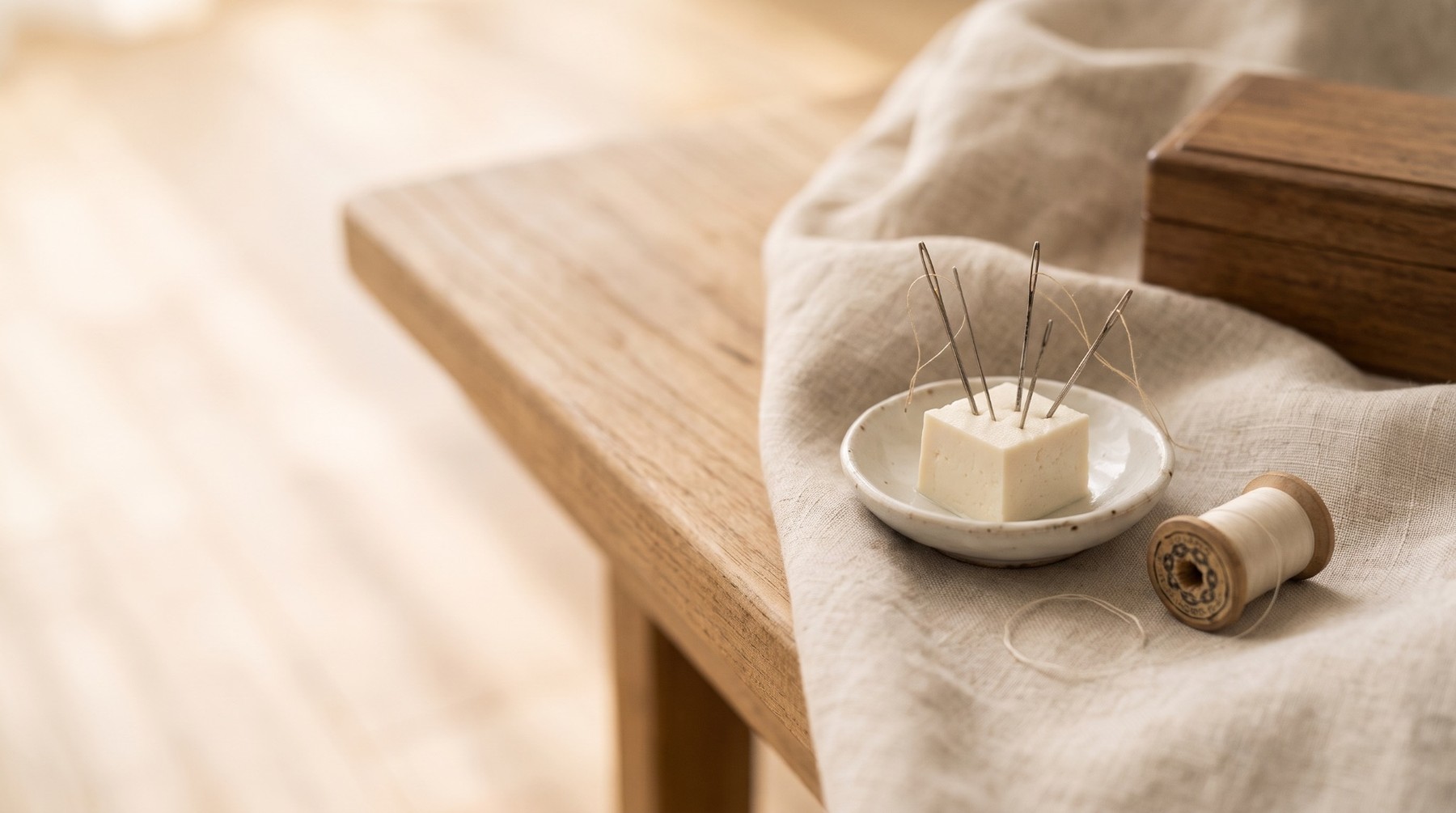
There are objects so small that we hardly notice how faithfully they remain beside us.
A needle slipping through fabric. A thread drawn carefully by hand. A quiet gesture repeated over many days, sometimes over many years.
In Japan, there is a tradition that offers thanks to these modest companions.
It is called Hari-kuyō (針供養), a memorial service for broken, bent, or worn sewing needles.
At first glance, the ritual may seem simple, perhaps even surprising. And yet, within it lives a deeply moving way of seeing the world.
To pause for something so small.
To acknowledge what has served us.
To offer rest, even to an object.
A Ceremony for Worn Needles
Hari-kuyō is traditionally observed in different parts of Japan, often in February or December depending on the region and local custom.
On this day, old sewing needles that have become too bent, dull, or fragile to use are taken to a temple or shrine.
Rather than being thrown away, they are placed gently into soft tofu or konnyaku.
The contrast is striking.
All year, the needle has passed through cloth, working with precision and firmness. At the end of its service, it is finally received by something tender.
This gesture is both practical and symbolic. The softness of tofu or konnyaku spares the needle from further strain, while expressing gratitude for the work it has done.
It is a small act of care.
And perhaps that is why it remains so touching.
More Than a Tool
Hari-kuyō belongs to a wider sensibility in Japan in which objects are not always treated as entirely lifeless or insignificant.
Tools can carry memory. They can bear the traces of labor, patience, repetition, and human intention.
A sewing needle may be humble, but it has participated in the making and mending of everyday life.
It may have helped shape a garment, repair a sleeve, or preserve something that would otherwise have been lost.
In honoring the needle, the ritual also honors the hands that used it.
The concentration of a seamstress. The quiet routine of domestic work. The careful attention required to mend rather than discard.
There is dignity in such work, even when it passes unnoticed.
The Meaning of Softness
What moves me most in Hari-kuyō is not only the gratitude it expresses, but the gentleness of its final gesture.
The needle is not simply set aside.
It is given relief.
After so much piercing, it is placed into softness.
There is a tenderness here that extends beyond the object itself.
It suggests another way of relating to usefulness and wear.
In many parts of modern life, things are quickly replaced as soon as they no longer function perfectly. What is bent is discarded. What is worn is forgotten.
Hari-kuyō offers another possibility.
It reminds us that even what can no longer be used may still deserve acknowledgment.
Not everything loses its value when its practical role comes to an end.
A Memory of Labor
The ritual has long been associated with sewing, craftsmanship, and the lives of those who worked with textiles.
Historically, it was especially meaningful to women whose days were shaped by mending, making, and caring through cloth.
Clothing, after all, is rarely only clothing.
It protects the body. It accompanies seasons. It absorbs traces of daily life.
To sew is often to care for what shelters another life.
A needle might therefore participate in something far larger than its size suggests.
The making of a kimono.
The repair of an apron.
The patience required to continue working by hand.
In this way, Hari-kuyō is not only about objects. It is also about invisible labor, inherited gestures, and the quiet histories held within ordinary materials.
What We Choose to Thank
There is a particular beauty in rituals that turn our attention toward what is usually overlooked.
A broken needle would be easy to ignore.
Yet Hari-kuyō asks us to notice it one last time.
To recognize that usefulness is not the only reason something matters.
I think this is one of the most luminous qualities of the tradition.
Gratitude does not begin with what is extraordinary.
It begins with seeing more clearly what has been beside us all along.
A tool.
A gesture.
A material.
A person.
So often, the most essential presences are also the least celebrated.
Rest as a Form of Respect
Perhaps one of the quiet lessons of Hari-kuyō is that rest itself can be an offering.
There are moments when the most respectful thing we can do is not to demand more.
Not more productivity.
Not more endurance.
Not more usefulness.
Simply to recognize what has already been given.
And to let it rest.
This is true for objects, but perhaps it is also true for ourselves.
There are forms of tiredness that do not ask to be solved, only acknowledged.
There are parts of us that have worked silently for a long time.
To meet them with softness may also be a kind of wisdom.
What Remains in Small Things
A needle is almost weightless in the hand.
And yet, within this small ritual, it carries an entire way of understanding care.
Hari-kuyō reminds us that meaning can live in gestures too modest to draw attention to themselves.
To thank what has served us.
To honor wear without shame.
To let usefulness give way to tenderness.
Perhaps this is why the ritual feels so quietly powerful.
It does not ask us to preserve everything forever.
Only to part with certain things gracefully.
With memory.
With gratitude.
With gentleness.
And sometimes, that may be enough.
To know that even the smallest things may deserve a resting place.