a little light for the road ahead.
A Chinese tradition of lanterns, reunion, and the hope we carry into a new year.
 By valentin
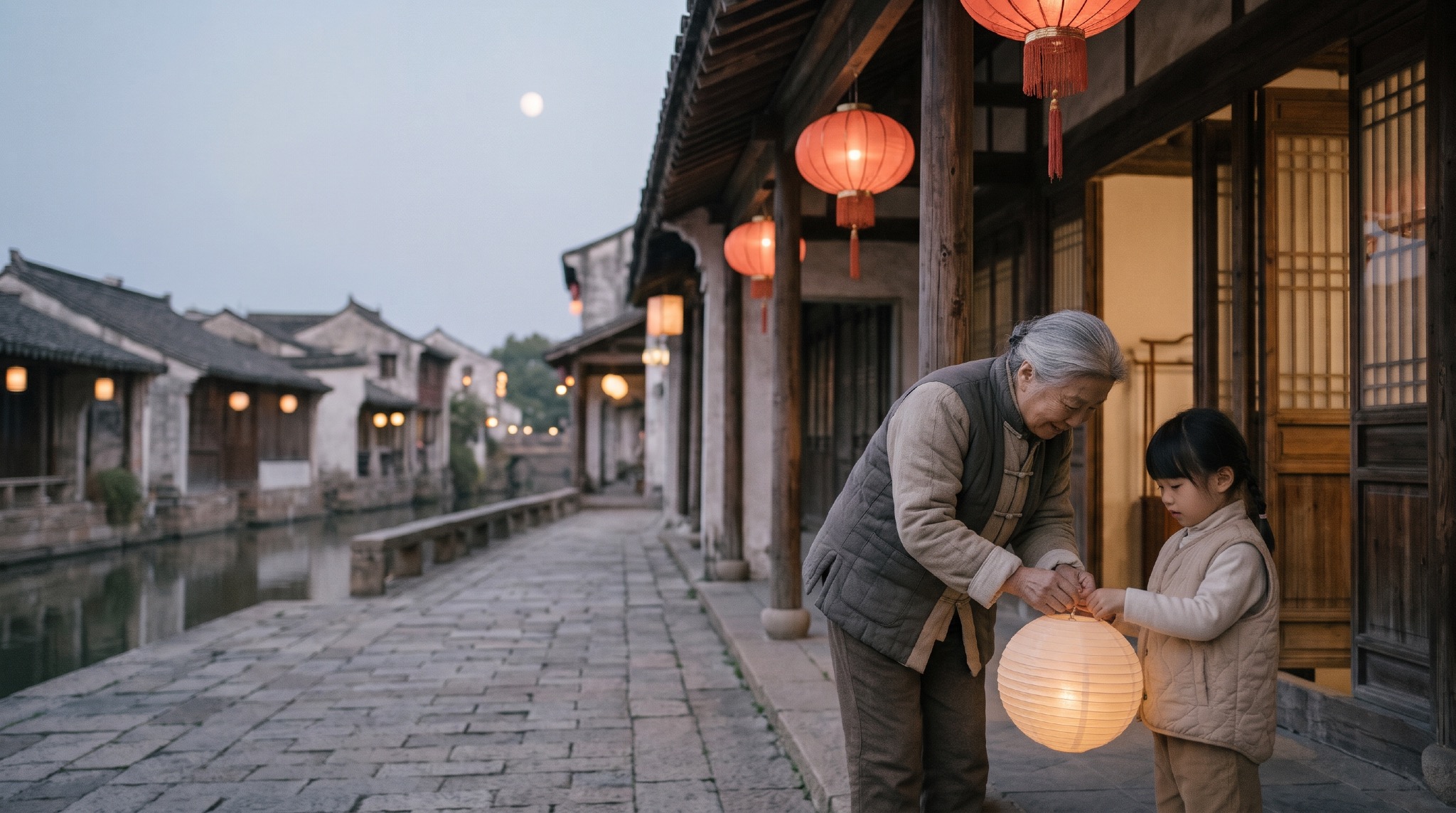
As evening settles over the rooftops, small lights begin to appear.
Beneath wooden eaves, along narrow streets, beside rivers and within family courtyards, lanterns bring warmth to the approaching night.
Their colors soften the darkness. Reflections move across the water. People leave their homes and gather beneath the first full moon of the new lunar year.
In China, this evening is known as Yuánxiāo Jié (元宵节), the Lantern Festival.
It brings the traditional celebrations of the Lunar New Year to a close, carrying with it wishes for happiness, harmony, and the months yet to come.
The Origins of an Illuminated Night
The Lantern Festival is rooted in a history extending back nearly two thousand years, although no single account fully explains its beginnings.
One traditional story takes us to the Eastern Han dynasty, during the reign of Emperor Ming, when Buddhism was gaining influence in China.
According to this account, the emperor encouraged lanterns to be lit in temples and the imperial palace on the fifteenth evening of the first lunar month, following a Buddhist practice of honoring the Buddha through light.
Over the centuries, religious observances, imperial celebrations, and regional folk customs became intertwined.
During the Tang and Song dynasties, lantern displays developed into increasingly elaborate public celebrations. Streets and courtyards were illuminated, artisans created intricate designs, and people gathered to enjoy an evening unlike any other.
What may once have accompanied an act of devotion gradually became part of a much wider cultural celebration.
Light found its way into the shared life of the community.
The Meaning of a Lantern
A traditional Chinese lantern is often made from a delicate framework covered with paper or silk.
Its construction requires care. The material must be shaped, supported, and assembled so that light can pass through it.
Lanterns take many forms, from simple rounded shapes to elaborate representations of flowers, animals, and figures drawn from folklore.
Red, a color widely associated with happiness and good fortune in Chinese culture, frequently appears alongside gold and other festive colors.
During the Lantern Festival, these illuminated objects express wishes for prosperity, peace, and a favorable year.
Yet there is also something remarkable about their physical nature.
A lantern does not conceal its source of light entirely, nor does it expose it completely. Its outer surface transforms the brightness within, allowing it to reach the surrounding space with a softer radiance.
I find something especially beautiful in this balance between fragility and warmth.
Beneath the First Full Moon
The festival takes place on the fifteenth day of the first month of the traditional Chinese lunisolar calendar.
It is an evening associated with the first full moon of the new year.
In Chinese culture, the roundness of the moon has long been connected with completeness and reunion.
This symbolism is also expressed through a traditional food known as tāngyuán (汤圆), small dumplings made from glutinous rice flour, sometimes filled with black sesame, peanuts, or sweet red bean paste.
In northern China, a related preparation known as yuánxiāo (元宵) is particularly associated with the festival.
Their rounded forms evoke the gathering of loved ones. The sound of the word tāngyuán also recalls tuányuán (团圆), meaning reunion.
A bowl placed at the center of a table becomes an expression of a wish that is both simple and deeply human: that those we love may find their way back to one another.
Walking Toward a Year of Well-Being
Among the older customs associated with the Lantern Festival is a lesser-known practice called zǒu bǎibìng (走百病), referring to the idea of walking away illnesses and misfortune.
Historically documented in northern China, particularly during the Ming and Qing dynasties, the custom often brought women outdoors in groups during the festival.
They would walk through the streets and cross bridges, believing that these actions could help ward off illness and encourage longevity.
The bridge became part of a symbolic passage toward better health.
Although the custom belongs to a particular historical and cultural context, its imagery remains touching.
To leave the familiar surroundings of one's home, to walk alongside others beneath illuminated streets, and to cross into a new year with wishes for well-being.
There is a sense of companionship in this ancient practice.
Whatever the coming months might bring, the journey did not have to begin alone.
A Night Belonging to Everyone
The Lantern Festival is not solely an occasion for solemn reflection.
It is also filled with curiosity, laughter, craftsmanship, and encounters.
One enduring custom involves attaching riddles to lanterns. Visitors gather around them, attempting to discover the answers hidden within carefully chosen words.
Children admire the illuminated figures. Families prepare seasonal food. Artisans share skills refined across generations.
The celebration gives people a reason to step outside and participate in something larger than their individual routines.
In a world where so much of life can become hurried and private, such occasions remind us of the importance of shared joy.
Happiness does not always need a remarkable event.
Sometimes it grows from being present among others, enjoying an evening that belongs equally to everyone.
The Light We Offer
What draws me to the Lantern Festival is not only the beauty of its illuminated streets, but the intention behind them.
Someone prepares a lantern.
Someone places it outside their home.
Someone passing by receives a little of its brightness.
There is no need for these people to know one another. The gesture has already created a small connection between them.
Perhaps kindness works in much the same way.
We rarely know how far the warmth of our actions travels, or how long a thoughtful gesture remains in another person's memory.
A word offered at the right moment, an unexpected act of generosity, the patience we show when someone is struggling.
These things may seem insignificant to us, yet they can become a source of comfort elsewhere.
We cannot illuminate every road.
But we can make the part of it we inhabit a little warmer.
Until the Morning Comes
Eventually, the celebrations come to an end.
The lanterns are extinguished, families return home, and the streets resume their ordinary appearance.
Morning arrives without the colors of the previous evening.
Still, something of that shared happiness may accompany those who experienced it.
The Lantern Festival reminds us that hope does not require certainty about what lies ahead. It can exist alongside the unknown, sustained by affection, generosity, and the company of others.
Perhaps this is enough for the beginning of a new year.
Not to know where every road will lead, but to carry a little warmth along the way.
And whenever we can, to leave a light for someone else.